Author: Theresa

  • A quick book TBR game

    A quick book TBR game

    Choosing the next book to read can be a lot of fun. But sometimes it can become overwhelming to choose. A book tbr game (meaning: to be read) can help and add a lot of extra fun to it too. What I myself like most about it is, that it challenges you to pick books, that you maybe have been putting of.

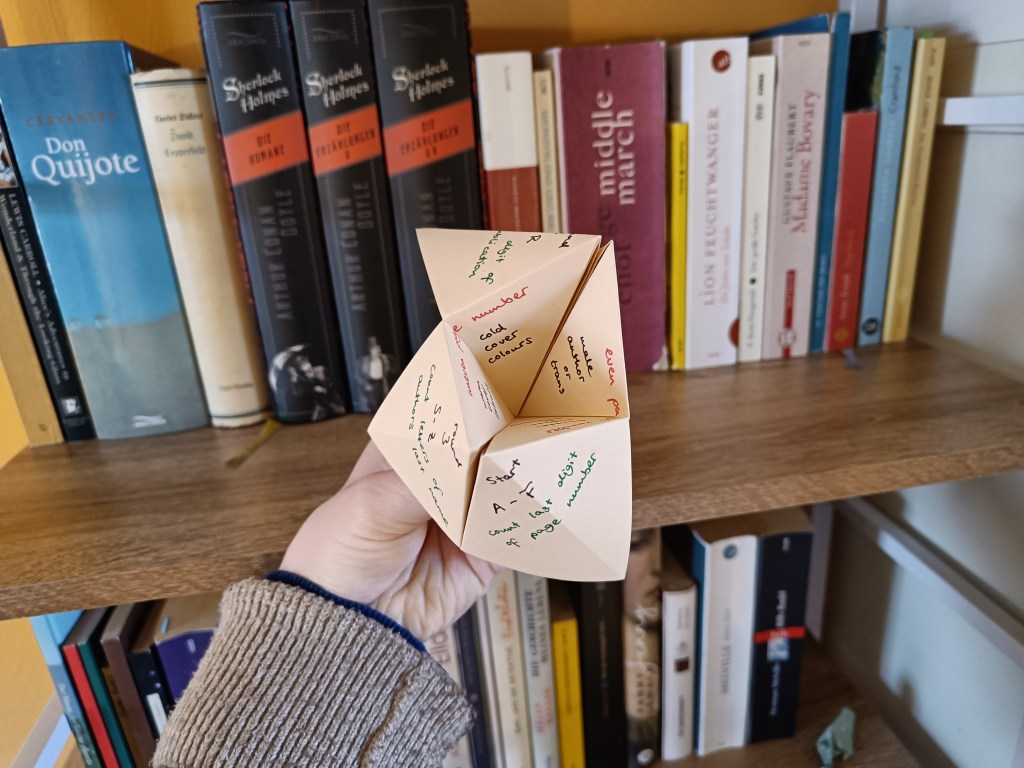
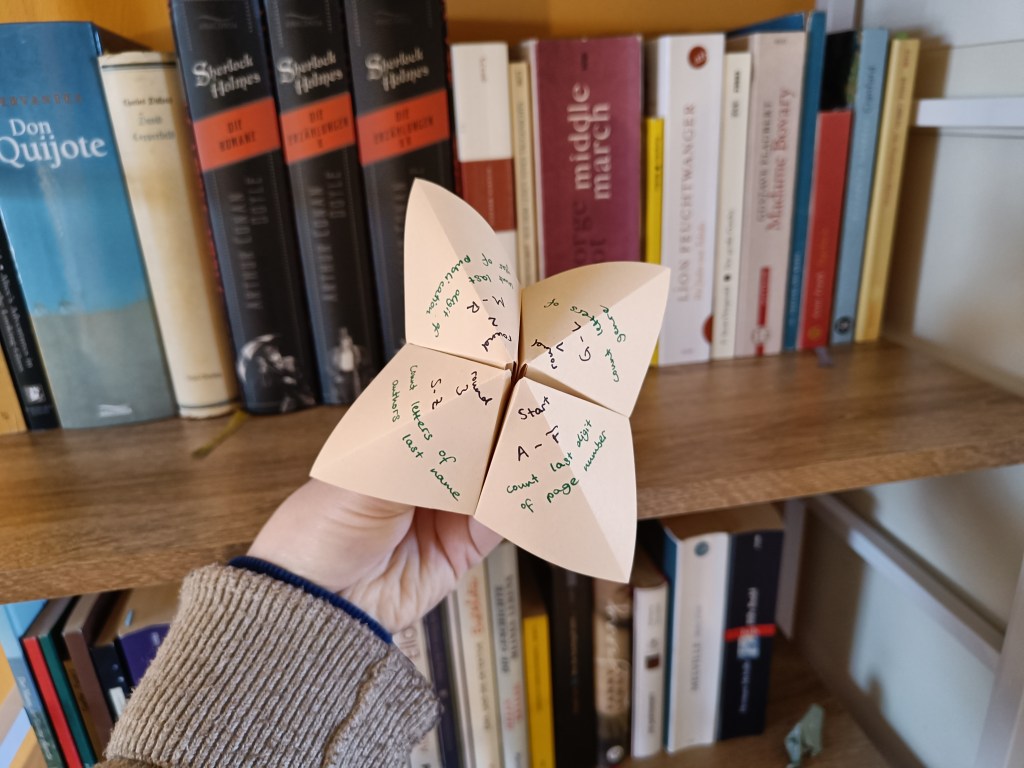
    One of my hobbies beside reading is doing Origami. So I thought about combining these two in using an Origami fortune teller as a tbr game. Though I came up with this idea myself, I am very sure that I am not the first one to come up with it. I looked it up before writing this post and there actually are some other variations of it already out there.

    First step: fold an Origami fortune teller

    You can look up some tutorials about it, since I will not explain it here for the sake of shortness. But it is very easy, you probably already know it from your childhood. Fortune tellers are (or at least were when I was young) a quite common game to play with.

    Second step: write the prompts

    In my version there are three “prompt-levels”.
    First level

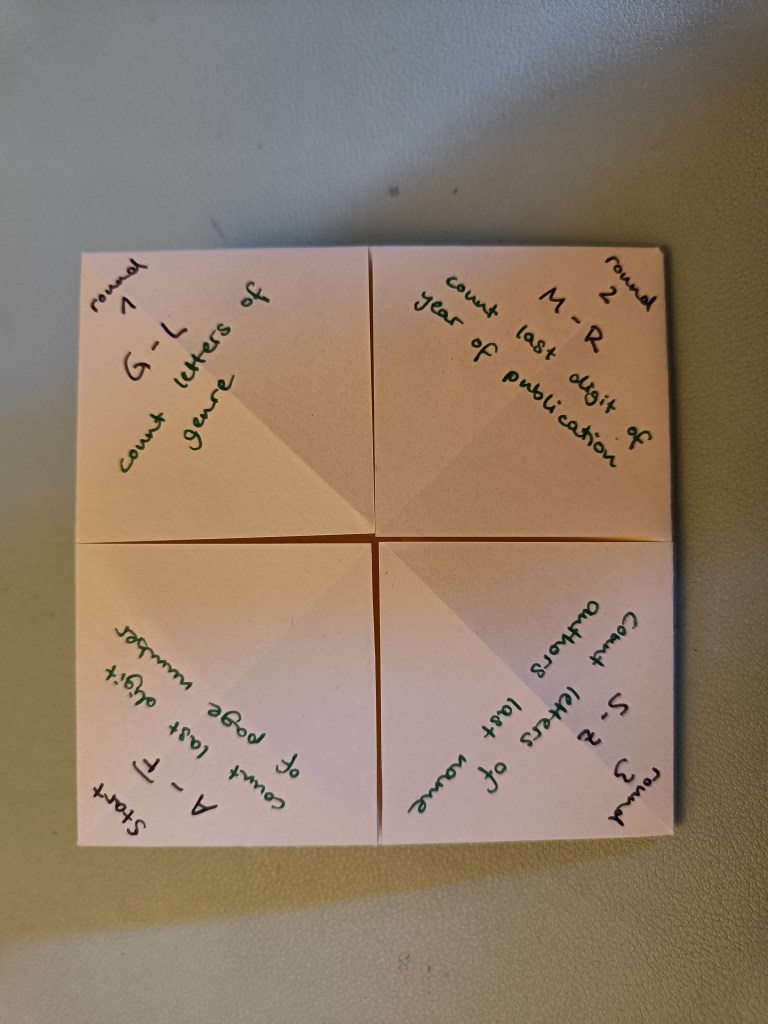
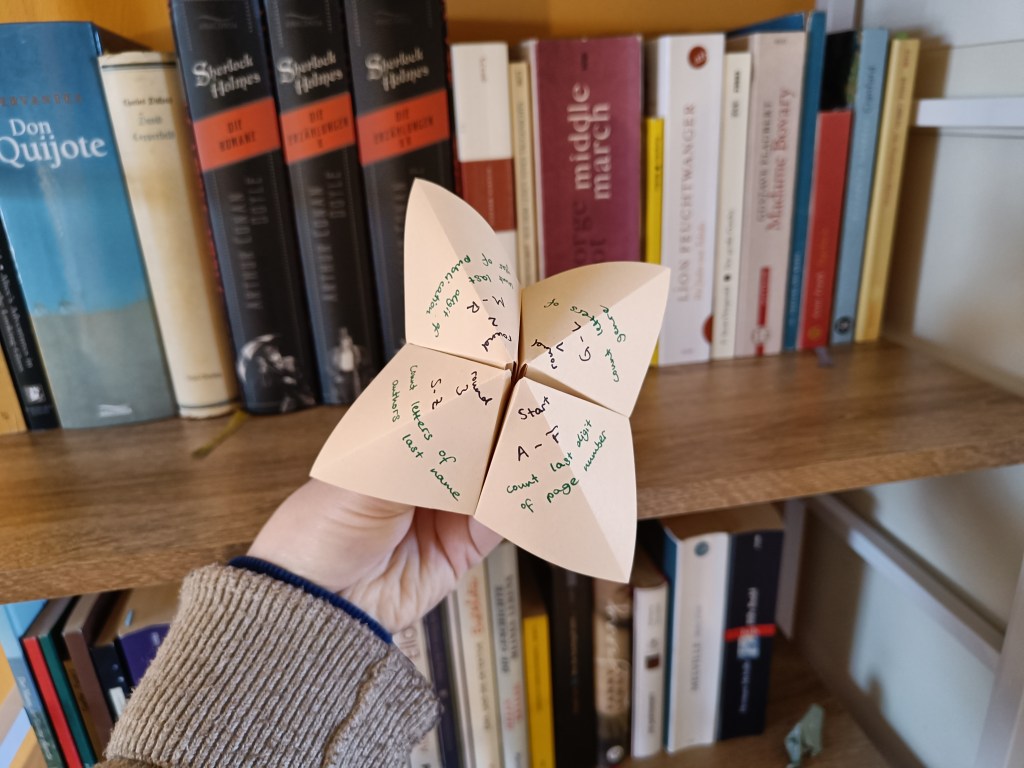
    This is the place, where the game will start. The prompts have to be written on the flaps, that will show up when the fortune teller is closed. In the original game these flaps are usually coloured. For this game I first numbered them, so that I don’t accidentally rotate them in my hand between rounds (that’s optional). Then I divided the alphabet in four parts and chose a number prompt for each side.

    So the four flaps are as following in my version (feel free to make it your own):

    • start / A-F / count last digit of page numbers
    • round 1 / G-L / count letters of genre name
    • round 2 / M-R / count last digit of publication year
    • round 3 / S-Z / count letters of author’s last name
    Second level

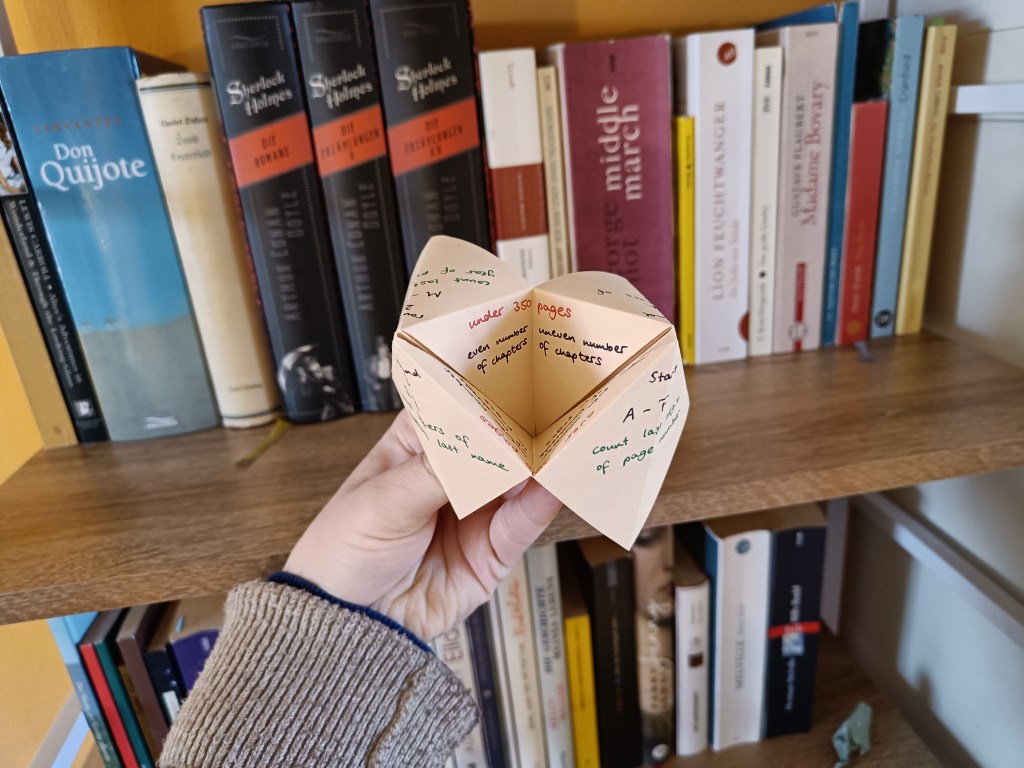
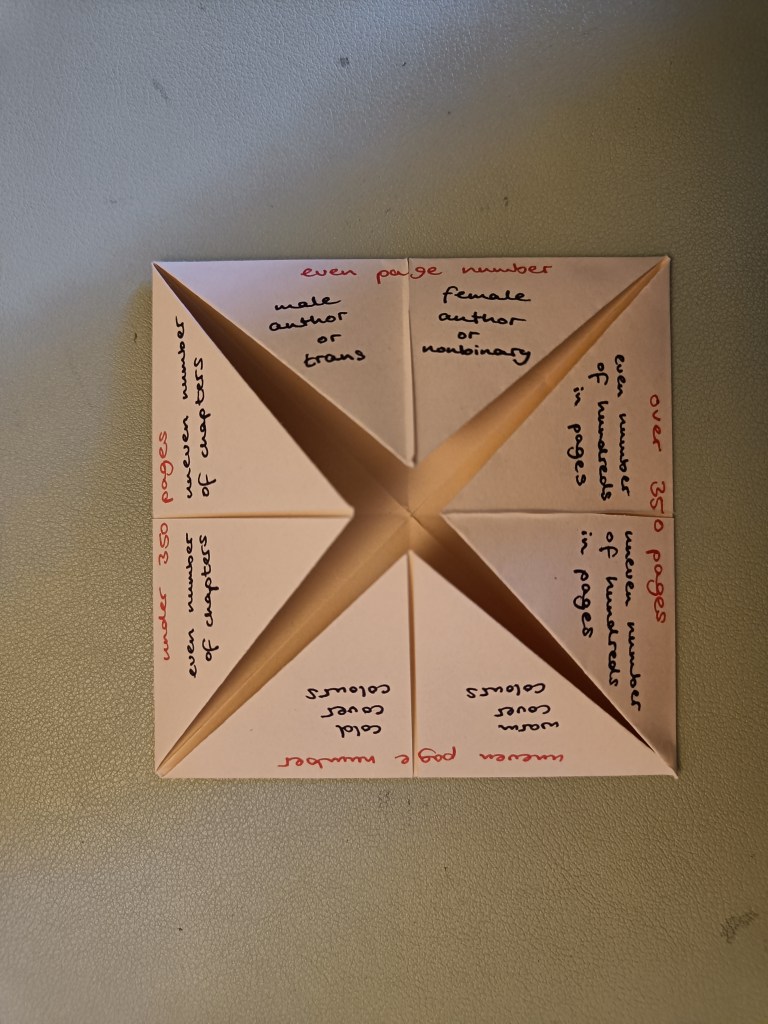
    This level is on the opposite side of the fortune teller. In the original game there are usually numbers here. Here you have to write two binary prompts opposite from each other. Secondly on each flap there are two other binary prompts to chose from (each side of the fold in the middle). I will explain the game later, don’t worry about it for now. 🙂

    So the flaps are as following in my version:

    • even page number: male or trans author / female or nonbinary author1
    • over 350 pages: even number of hundreds in pages / uneven number of hundreds in pages
    • uneven page number: warm cover colours / cold cover colours
    • under 350 pages: even number of chapters / uneven number of chapters
    Third level

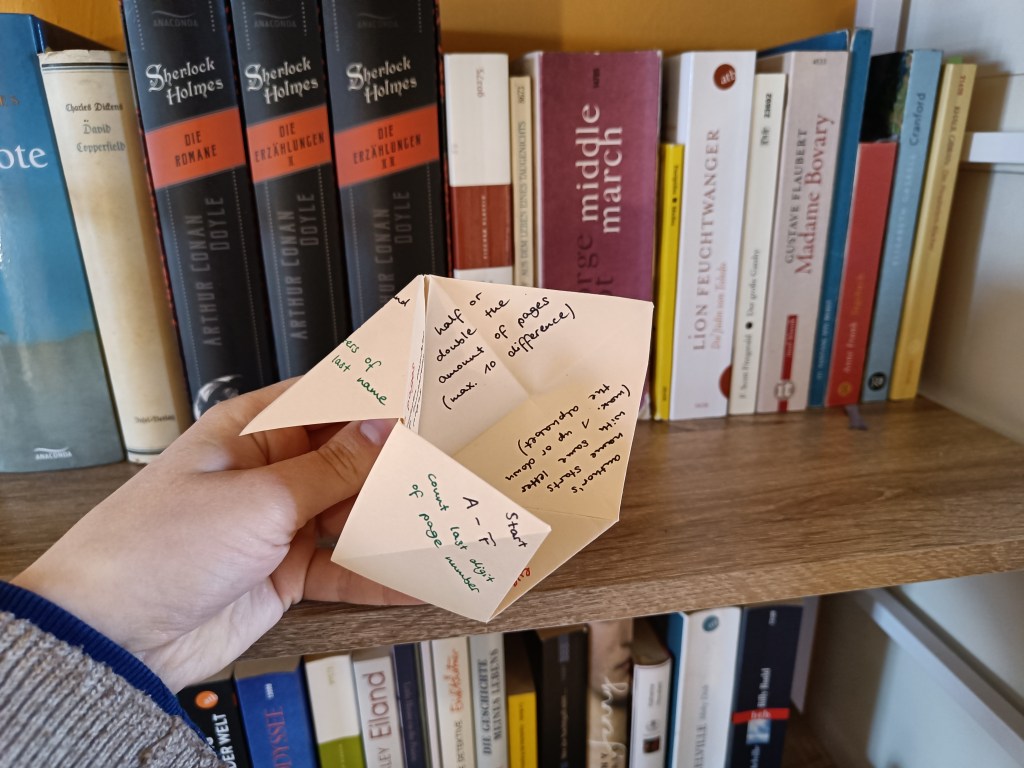
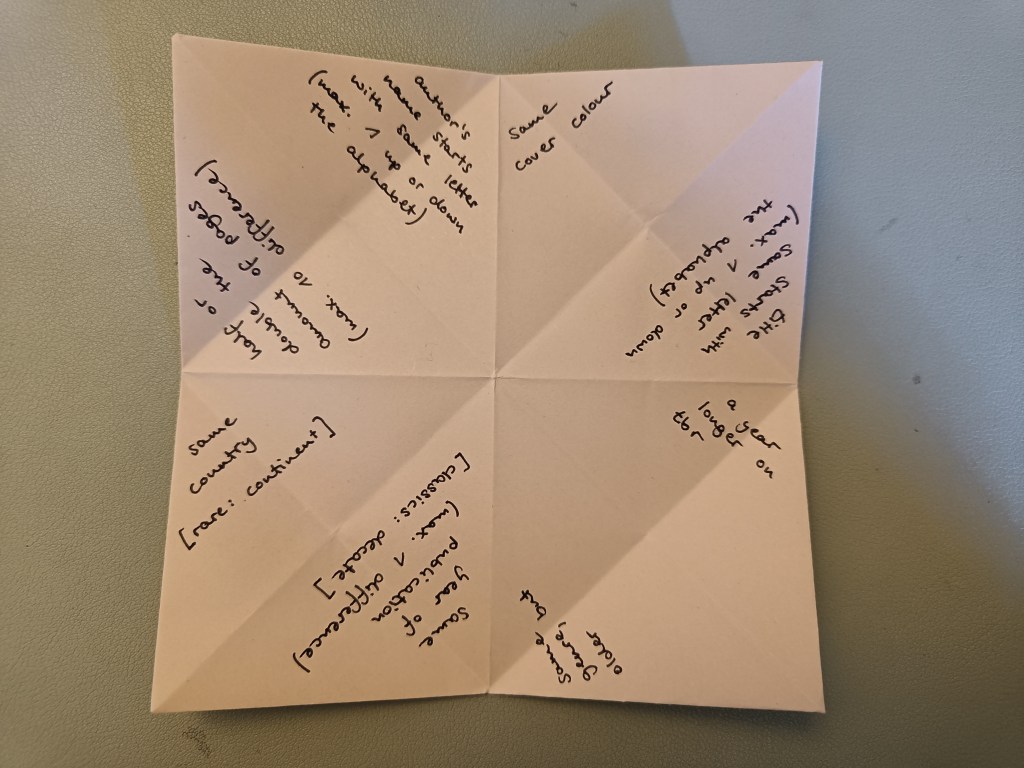
    If you open the flaps of the second level you are on the third level. (I swear, I am making this more complicated than it is.) Here you can chose 8 different prompts as you like.

    My prompts are:

    • same publication year (for classics: same decade)
    • same country (author)
    • half or double the amount of pages
    • author’s name starts with the same letter
    • same cover colour
    • title starts with the same letter
    • same genre, but older
    • a year longer on my tbr

    Now you can close it all back up and you are done.

    How to play the tbr game
    1. You start with the book you last finished.
      • example: I just finished “The Two Towers” by J. R. R. Tolkien.
    2. Then you put the “start” on your right thumb (optional). Now choose the flap that has the letter of the author’s last name included.
      • example: Tolkien starts with a T, so I choose the prompt “count letters of author’s last name”. That is 7.
    3. Count the given number with the fortune teller (meaning opening and closing it the way, that the first prompts on second level are matching).
    4. Now choose the correct side in answering the first binary prompt on second level.
      • example: Counting to 7 brought me to uneven/ even page number. My edition has 510 pages, so even.
    5. Answer the second binary prompt on second level.
      • example: The side of even page numbers has the prompts “male/ trans or female/ nonbinary”. Tolkien is a male author.
    6. Open the flap and pick a book fitting the prompt underneath the correct side.
      • example: Prompt underneath is “same cover colour”. The cover of my edition is brown-ish. My edition of “Paradise lost” by John Milton has a brown cover. So this is my pick.
    7. Scavenger hunt: I prefer to now repeat the game three more times with the picked books and then take to last one as my actual tbr pick. That way you have a little scavenger hunt through your book shelves and don’t immediately know your final book.
      • example: Now I play the game with “Paradise Lost” instead of “The Two Towers” and so on.

    This is my little version of a tbr game. You don’t need a lot of material or craftsmanship to make one yourself. It is a lot of fun to play and can truly help finding books on your tbr, that you maybe haven’t thought about.

    Now I hope, you have a lovely rest of your day! 🙂

    1. I divided it this way, because I wanted the flaps to be chosen about the same amount of times. First disclaimer: gender is a spectrum. Second disclaimer: Here it is unimportant if a trans author is male or female, I am obviously not saying, that a trans person counts as male or a nonbinary person as female! I just chose the most common gender identifications that are represented on my shelves and divided them for the two flaps. Third disclaimer (because the topic is important to me): I could have left trans out of it, because a trans woman is a female author and so on. ↩︎
  • Five of my favourite books of all time

    Five of my favourite books of all time

    (counts as an unpaid ad)

    Finding a favourite book is kind of magical. It is not just about quality, there are many excellent books in the world, a favourite book is a matter of the heart. A feeling of connection with the book.

    Here I wanted to share some of my all time favourite books, so you can learn a bit about my personal reading taste and maybe even find a new favourite too. This list is absolutely to short and shows more random examples of favourite books of mine rather than my top five favourite books.

    A childhood favourite book

    There are books in our childhood or youth, that we can never really left behind.

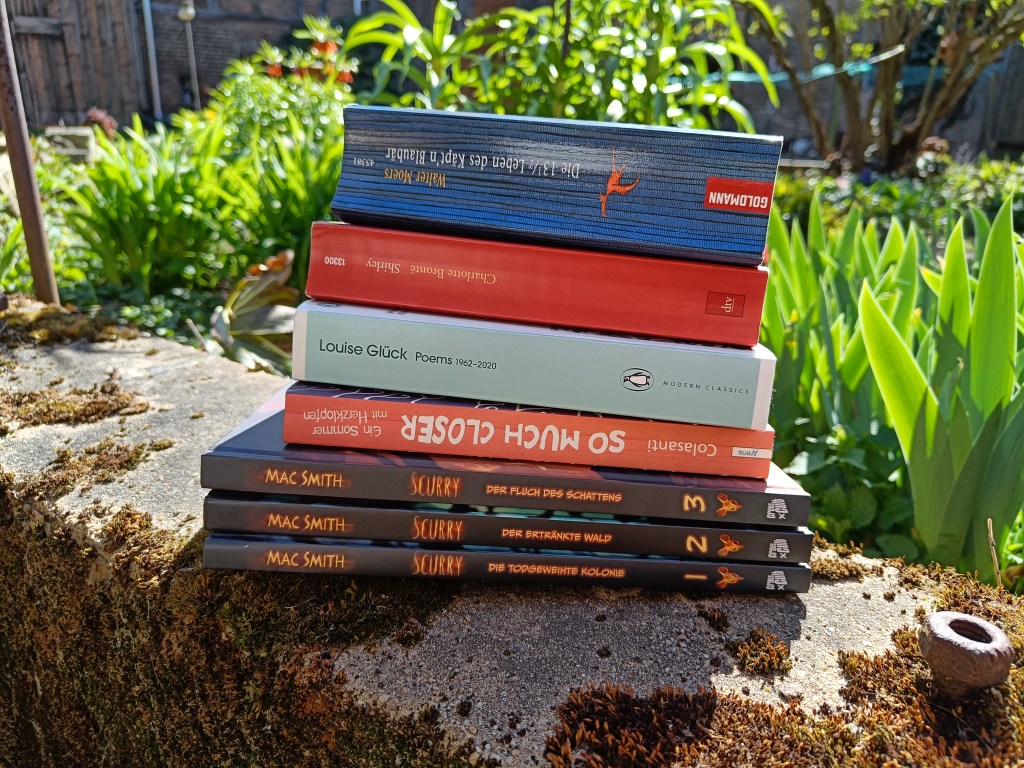
    “So Much Closer” by Susane Colasanti (2013)

    “So Much Closer” is a young adult book that is dear to my heart. Here we follow high school student Brooke, who moves to her dad in New York City just to be near Scott, who she unrequited loved for a long time. Brooke is gifted, but doesn’t care about school or her talents. While she tries to make Scott fall in love with her, she meets another boy named John, who has a learning disability and quite a different world view to her. As she spends more time with him, she starts to realize, that maybe her life is actually her own to live.

    Without becoming to personal I can say, that as a neurodivergent person I felt very seen in Brooke’s and also John’s story. I haven’t read the book in quite some time, but still feel very warm and held when thinking about it.

    A favourite classic

    Classic literature became one of my favourite genres quite early. I don’t know, when I read my first classic and it doesn’t matter to me. But I started reading them regularly at the age of fourteen.

    “Shirley” by Charlotte BrontĂ« (1849)

    My first favourite classic author was Charlotte BrontĂ« after I read “Jane Eyre”. Now (about ten years later) I still really love Charlotte BrontĂ«’s work, although my taste did change a lot over the years. For me her best work is definitely “Shirley”. It is a story about two very different young women Shirley and Caroline finding their place in a narrow society, about deep love and pain, about marriage, money, family dynamics and politics. The book also tells a lot about early English industrialization and the state of the clergy at the time. Shirley is a quite emancipated, independent woman, Caroline is more quiet and shy.

    Both are interesting characters to follow. Charlotte BrontĂ«’s writing style is just beautiful, but still easy to read. “Shirley” is a complex book full of sorrow and at the end hope.

    A fantasy favourite

    Fantasy is one of my most read genres. I love the endless possibilities and whimsy they offer.

    “The 13.5 Lives Of Captain Bluebear” by Walter Moers (1999)

    “The 13.5 Lives Of Captain Bluebear” is the first book in the Zamonia series (of interconnected stand alones) by one of the most popular German fantasy authors. To accurately describe this book is impossible. Here we follow the life of an orphan blue bear called Bluebear and his adventures through the continent Zamonia, when he gets stuck in a tornado, lives with the tiny pirates or becomes a gladiator of lies.

    This book is absurd at times. Maybe most of the time. With Zamonia Moers created a colourful world full of fantastical beings, fairy tales and otherworldly places that is different to most other fantasy worlds I read about. Illustrated by the author himself and including creative ways to express the story also through the font size or style, it is a joy to discover the complexity of this weird continent.

    A favourite graphic novel

    I discovered my love for illustrated books and graphic novels just a few years ago. I took an Indology course in university about Indian comics and graphic novels and continued reading them after. And here I am, counting graphic novels (and other largely illustrated books) as one of my favourite genres of literature.

    “Scurry” by Mac Smith (2023)

    I have a special interest in mice. They are amazing. Because of that I pretty much have to collect every book I find, that features mice. One of them (actually most of them) made it to list of favourite books. It is a post-apocalyptic graphic novel called “Scurry”. “Scurry” is a story about a group of brave mice, trying to find food and survive after the apocalypse, that destroyed humanity. Obviously the world is dangerous for the little creatures, enemies everywhere. But the danger also comes from within the group: a uproar is taking place.

    I just love this book, ok? It made me smile, cry and made me feel a deep love for it’s characters and how they are working together, even across species. At the same time parts are quite profound and wise. The art style is fittingly a bit dark, but beautiful to look at and detailed (which I love).

    A favourite poetry collection

    Poetry is underrated.

    “The Wild Iris” by Louise GlĂĽck (1993)

    Louise GlĂĽck is one of my favourite authors. And out of all her poetry (that I read) “The Wild Iris” speaks the most to me. I love nature writing in poetry. Her poems link nature with a nearly mythological writing. The collection spans a day from morning to evening, a garden from spring to autumn and in between pretty much a whole life.

    Her poems are moving and emotional. The writing is exquisite. There is so much to uncover, but at the same time the poetry can absolutely stand on it’s own. The German translation by the way (read them in a bilingual edition) by Ulrike Draesner is skillful and also wonderful to read.

    A few words at the end

    I am running out of words. There are so many other books I would love to include here, but I wanted to keep it short, mostly for my own sanity. Talking about the things one loves is not always easy. You often just love them for what they are, it doesn’t always have a logical reason. So please excuse my inadequate words for these books.

    Maybe a book grabbed your attention and you want to try it yourself.

    For now, that’s all from me. I hope, you have a lovely rest of your day. Bye!

  • Welcome to Resabook

    Welcome to Resabook

    Hey, hello and willkommen my name is Theresa and I am an avid reader from Germany. On this blog I want to share my interest in and love for reading and literature. Although I am mostly reading my books translated to (or original in) German, I love the international connection of the book community, which is why I chose to write this blog in English. Since English is not my first language, there will likely be some mistakes here and there. Also my usage of commas will probably be a bit German-esque. Please forgive me for that. 🙂

    What will I write about?

    Well, books, obviously. My favourite genres are (female) classics, poetry, fantasy, romance and graphic novels. But I will read pretty much any genre, if the book catches my interest. I prefer more positive and uplifting books, that also show that profundity doesn’t imply general darkness. There is nothing more complex than happiness in my opinion and I refuse to put darkness intellectually over light.

    Apart from the books, that I read, I will probably write more generally about reading every now and then.

    A disclaimer (kind of)

    If I write about a book that I read in German, I will still call it by it’s English title, but please be aware that a translation can be a bit of an interpretation of a book and may read differently than in an other language. Also, if you too are not a native English speaker and there is a translation to you first language, feel free to support that. Translating is an art, that I love to support! ❤