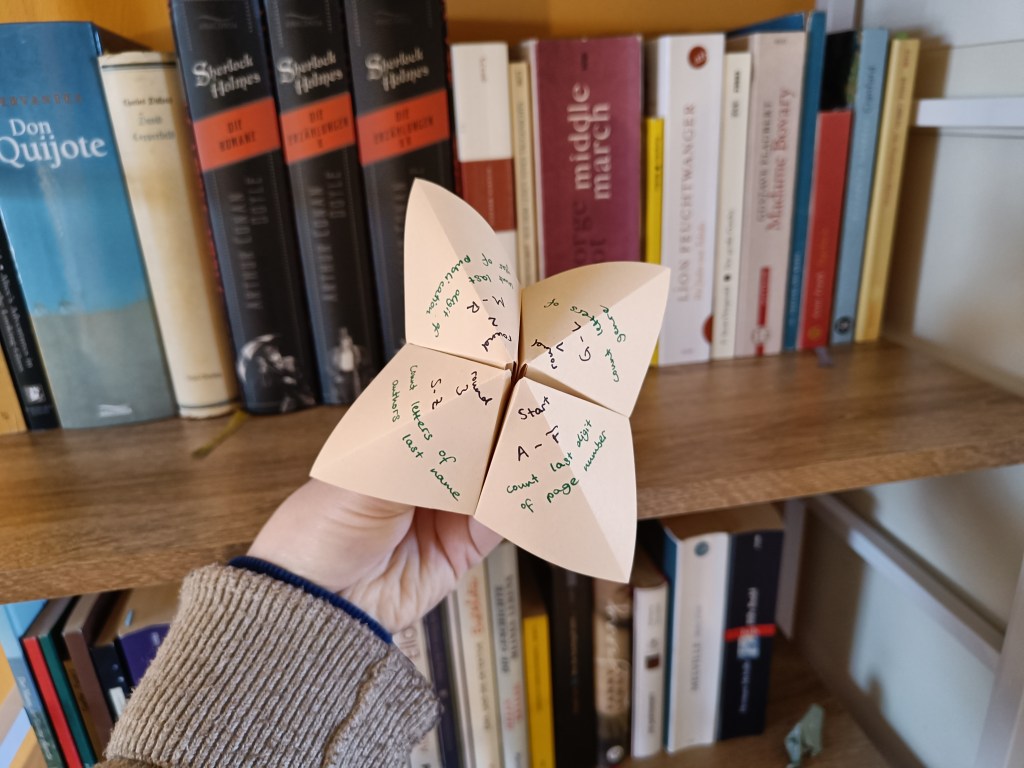
Choosing the next book to read can be a lot of fun. But sometimes it can become overwhelming to choose. A book tbr game (meaning: to be read) can help and add a lot of extra fun to it too. What I myself like most about it is, that it challenges you to pick books, that you maybe have been putting of.
One of my hobbies beside reading is doing Origami. So I thought about combining these two in using an Origami fortune teller as a tbr game. Though I came up with this idea myself, I am very sure that I am not the first one to come up with it. I looked it up before writing this post and there actually are some other variations of it already out there.
First step: fold an Origami fortune teller
You can look up some tutorials about it, since I will not explain it here for the sake of shortness. But it is very easy, you probably already know it from your childhood. Fortune tellers are (or at least were when I was young) a quite common game to play with.
Second step: write the prompts
In my version there are three “prompt-levels”.
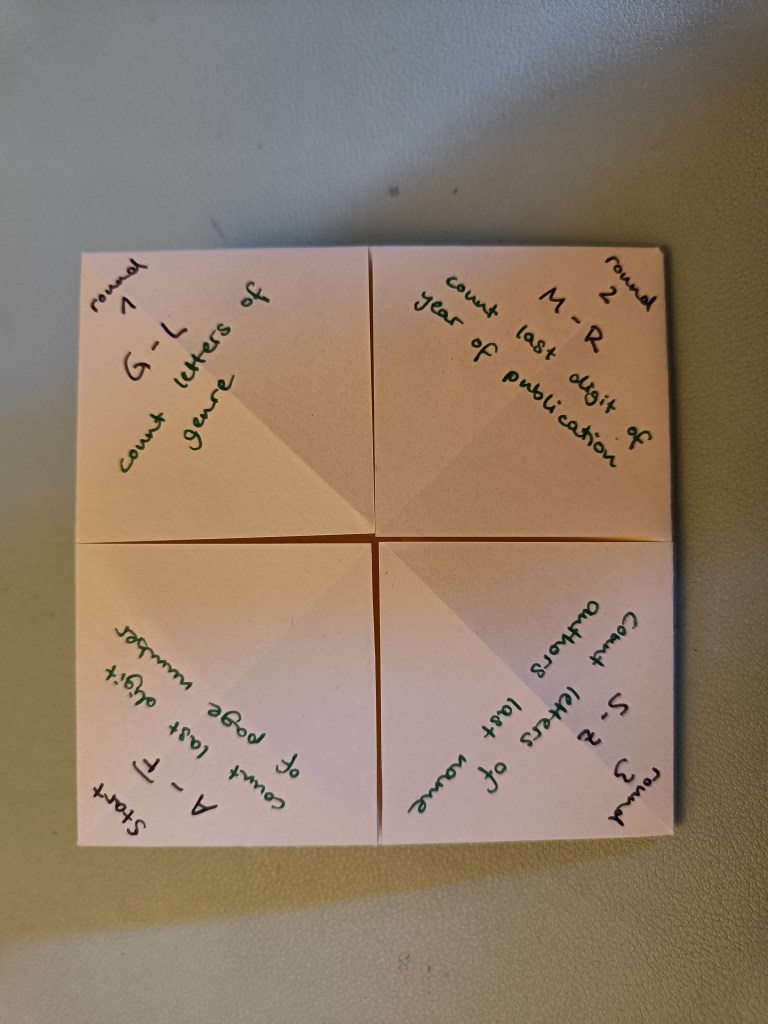
First level
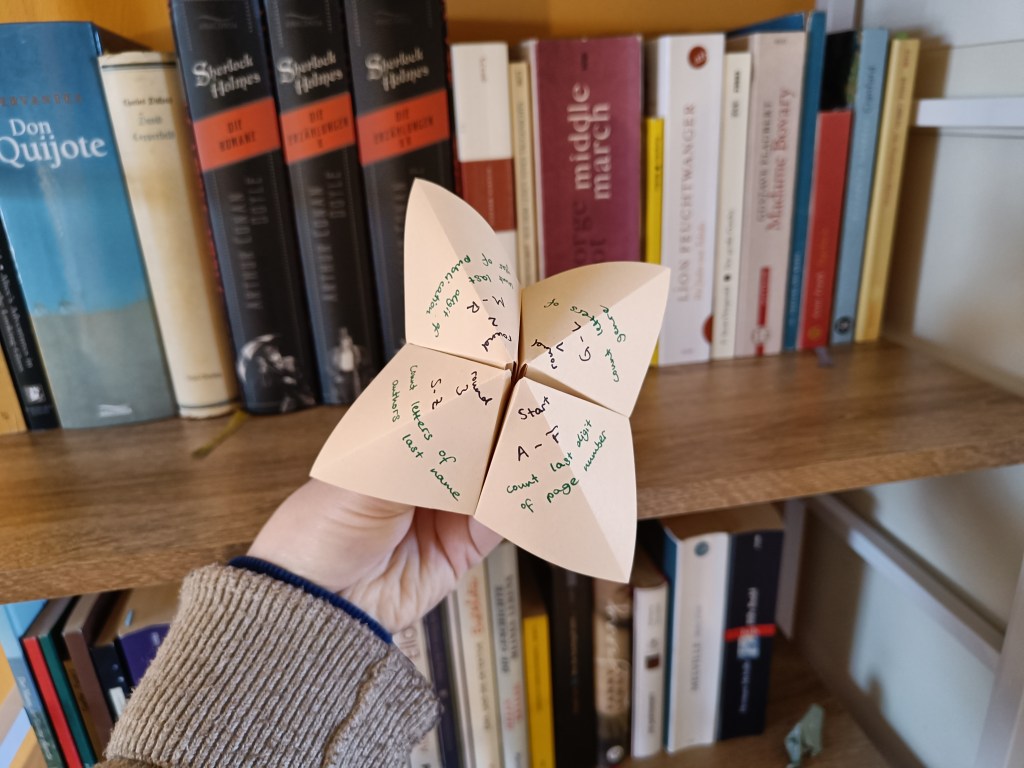
This is the place, where the game will start. The prompts have to be written on the flaps, that will show up when the fortune teller is closed. In the original game these flaps are usually coloured. For this game I first numbered them, so that I don’t accidentally rotate them in my hand between rounds (that’s optional). Then I divided the alphabet in four parts and chose a number prompt for each side.
So the four flaps are as following in my version (feel free to make it your own):
- start / A-F / count last digit of page numbers
- round 1 / G-L / count letters of genre name
- round 2 / M-R / count last digit of publication year
- round 3 / S-Z / count letters of author’s last name
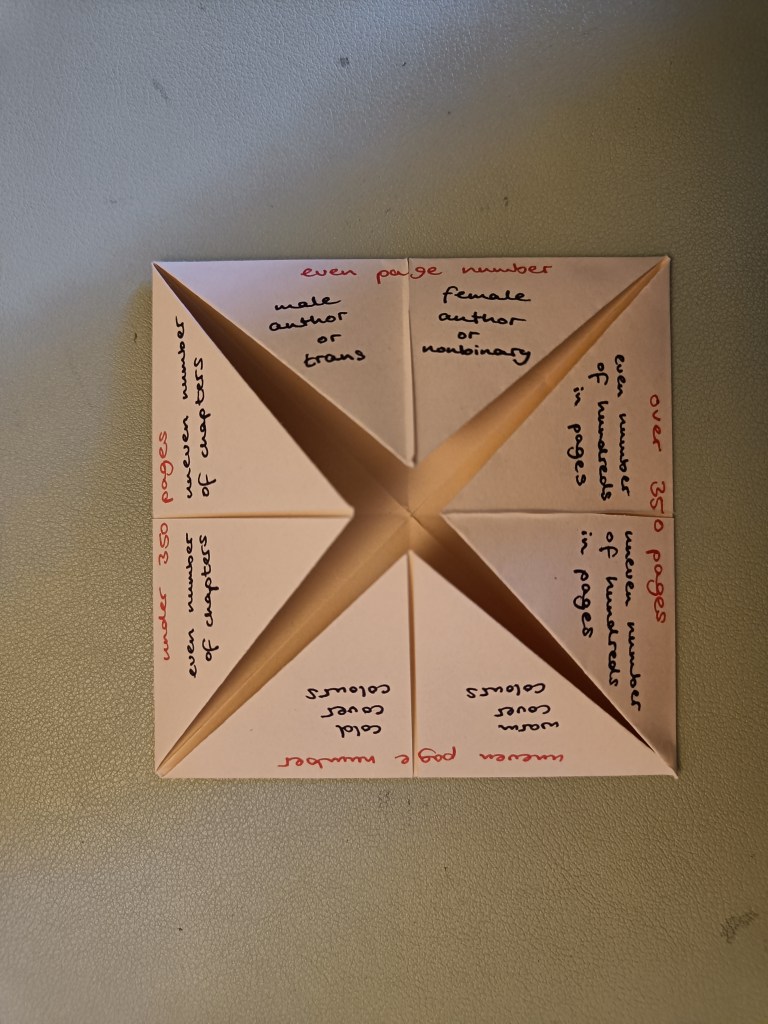
Second level
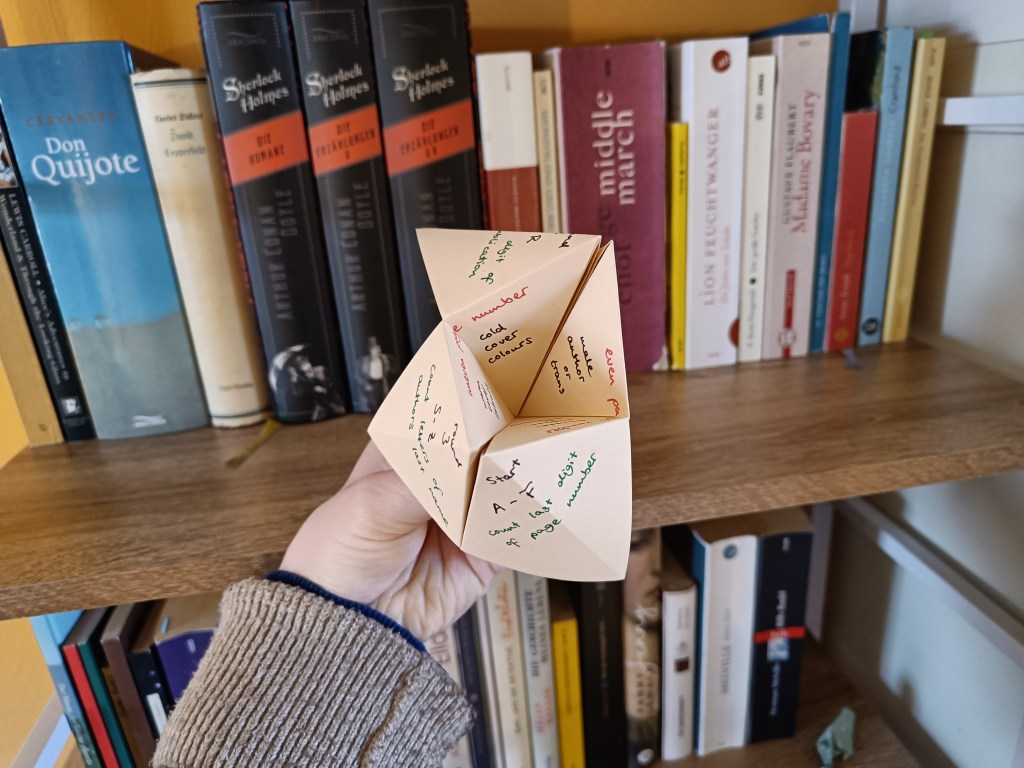
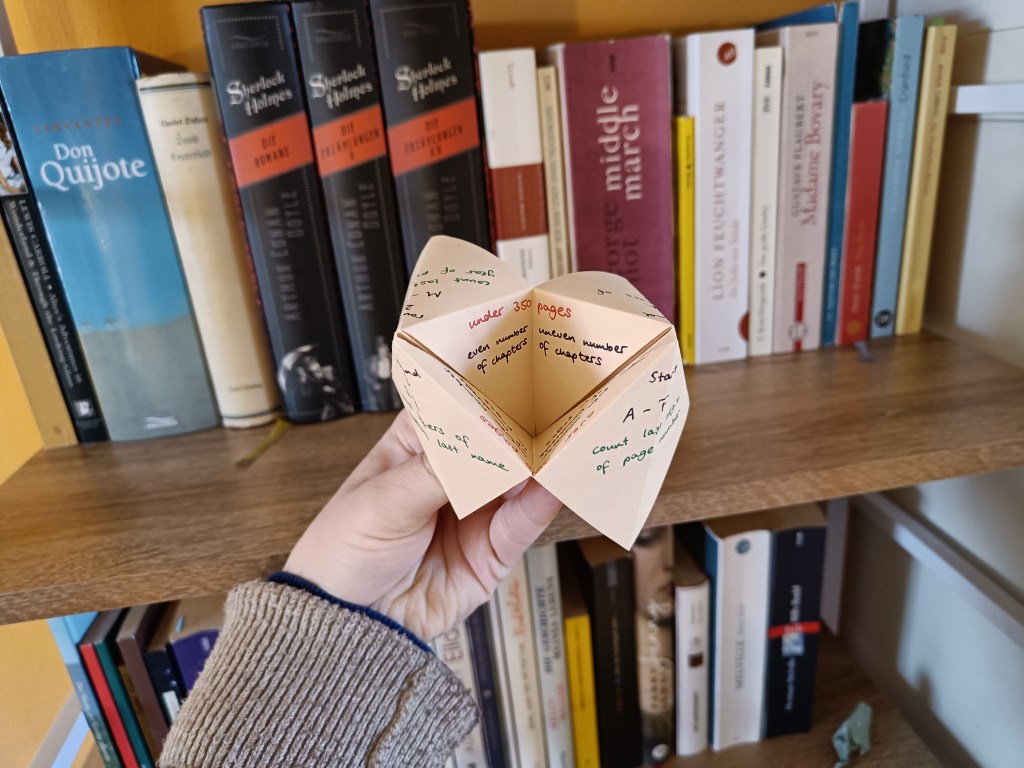
This level is on the opposite side of the fortune teller. In the original game there are usually numbers here. Here you have to write two binary prompts opposite from each other. Secondly on each flap there are two other binary prompts to chose from (each side of the fold in the middle). I will explain the game later, don’t worry about it for now. 🙂
So the flaps are as following in my version:
- even page number: male or trans author / female or nonbinary author1
- over 350 pages: even number of hundreds in pages / uneven number of hundreds in pages
- uneven page number: warm cover colours / cold cover colours
- under 350 pages: even number of chapters / uneven number of chapters
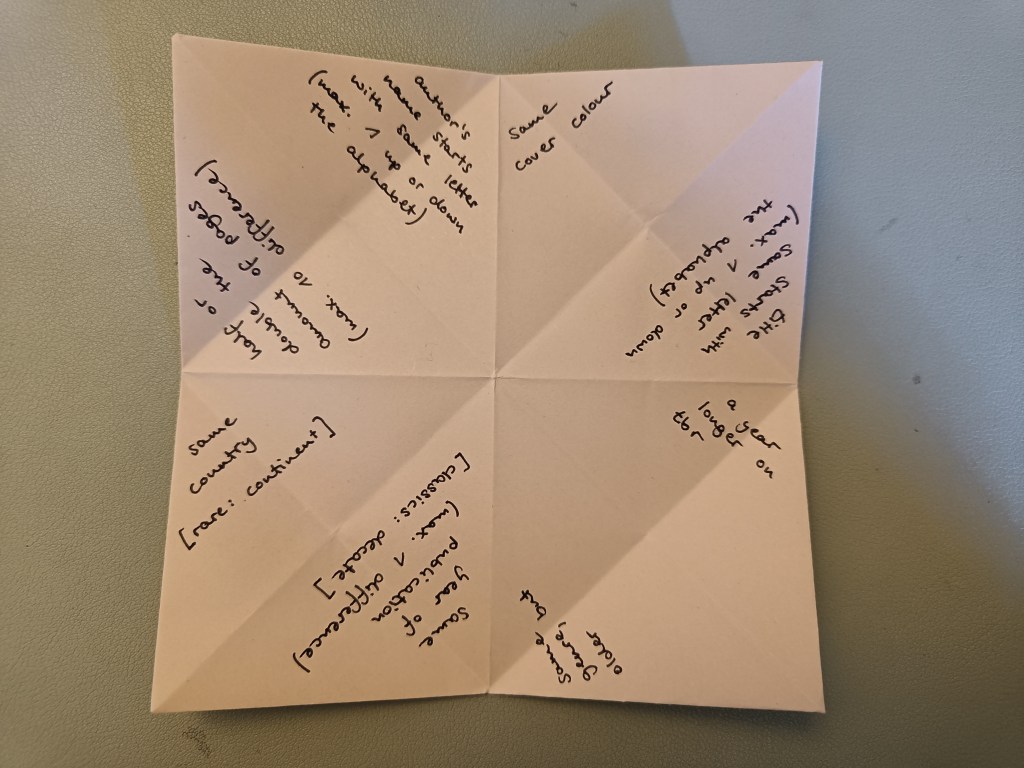
Third level
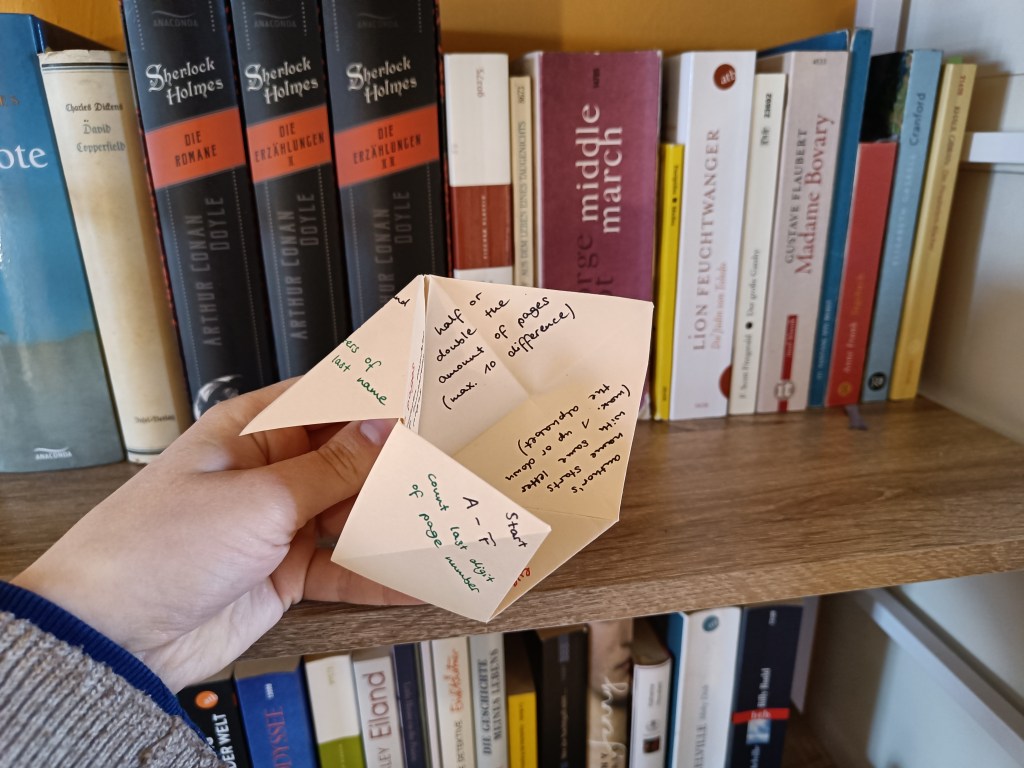
If you open the flaps of the second level you are on the third level. (I swear, I am making this more complicated than it is.) Here you can chose 8 different prompts as you like.
My prompts are:
- same publication year (for classics: same decade)
- same country (author)
- half or double the amount of pages
- author’s name starts with the same letter
- same cover colour
- title starts with the same letter
- same genre, but older
- a year longer on my tbr
Now you can close it all back up and you are done.
How to play the tbr game
- You start with the book you last finished.
- example: I just finished “The Two Towers” by J. R. R. Tolkien.
- Then you put the “start” on your right thumb (optional). Now choose the flap that has the letter of the author’s last name included.
- example: Tolkien starts with a T, so I choose the prompt “count letters of author’s last name”. That is 7.
- Count the given number with the fortune teller (meaning opening and closing it the way, that the first prompts on second level are matching).
- Now choose the correct side in answering the first binary prompt on second level.
- example: Counting to 7 brought me to uneven/ even page number. My edition has 510 pages, so even.
- Answer the second binary prompt on second level.
- example: The side of even page numbers has the prompts “male/ trans or female/ nonbinary”. Tolkien is a male author.
- Open the flap and pick a book fitting the prompt underneath the correct side.
- example: Prompt underneath is “same cover colour”. The cover of my edition is brown-ish. My edition of “Paradise lost” by John Milton has a brown cover. So this is my pick.
- Scavenger hunt: I prefer to now repeat the game three more times with the picked books and then take to last one as my actual tbr pick. That way you have a little scavenger hunt through your book shelves and don’t immediately know your final book.
- example: Now I play the game with “Paradise Lost” instead of “The Two Towers” and so on.
This is my little version of a tbr game. You don’t need a lot of material or craftsmanship to make one yourself. It is a lot of fun to play and can truly help finding books on your tbr, that you maybe haven’t thought about.
Now I hope, you have a lovely rest of your day! 🙂
- I divided it this way, because I wanted the flaps to be chosen about the same amount of times. First disclaimer: gender is a spectrum. Second disclaimer: Here it is unimportant if a trans author is male or female, I am obviously not saying, that a trans person counts as male or a nonbinary person as female! I just chose the most common gender identifications that are represented on my shelves and divided them for the two flaps. Third disclaimer (because the topic is important to me): I could have left trans out of it, because a trans woman is a female author and so on. ↩︎
 Resabook blog